A model T-bar, developed through physical modelling
HTC-210: A model T-bar, developed through physical modelling
Donor: National Geotechnical Centrifuge Facility, The University of Western Australia; TC 209 Offshore
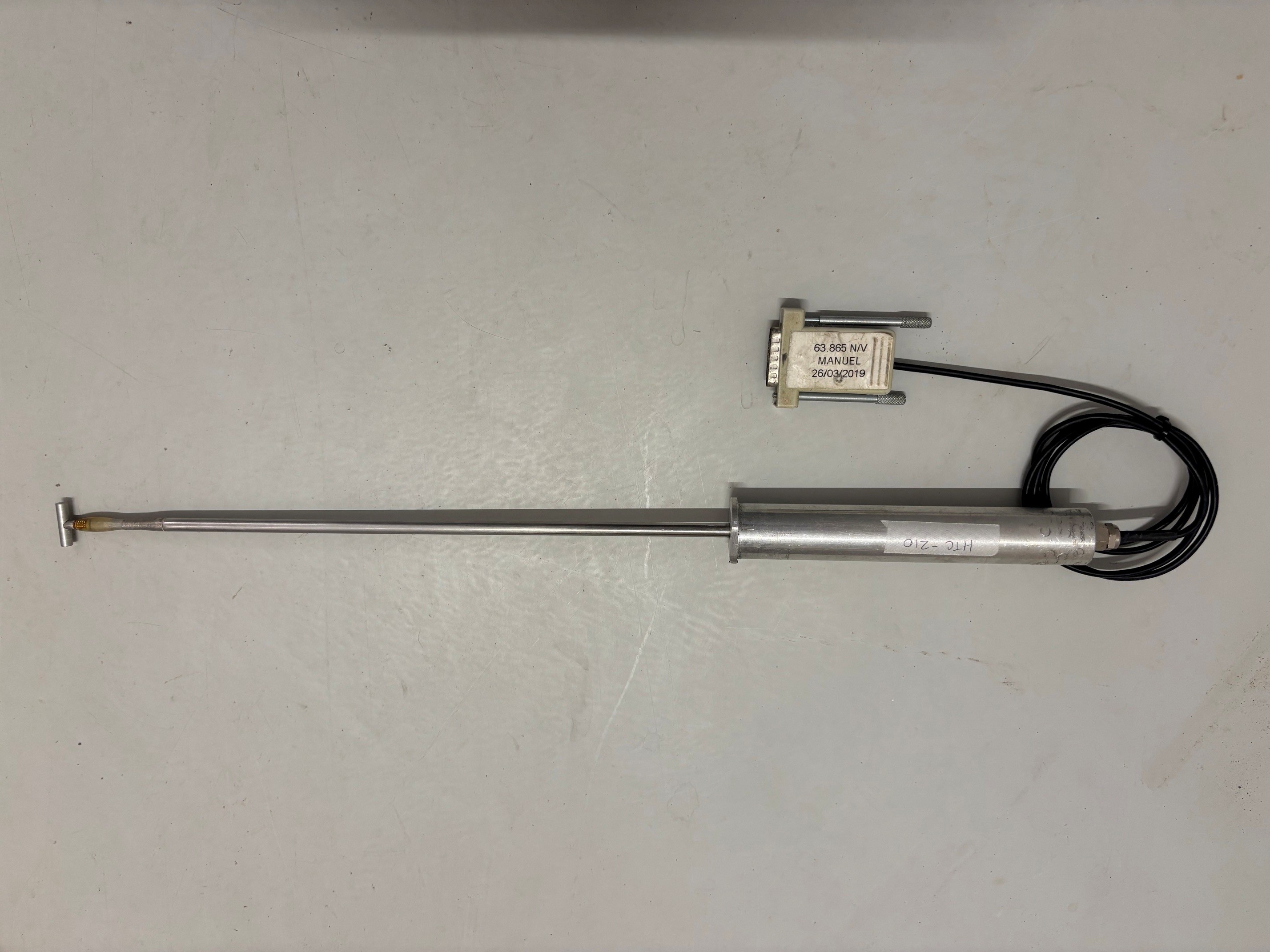
The T-bar penetrometer was developed in the 1990s by Professor Mark Randolph and Dr Doug Stewart as an alternative to the use of model scale cone penetrometers to measure the strength of soft clay centrifuge samples. The tool measures the penetration resistance acting on a cylindrical bar measuring 5 mm in diameter and 20 mm in length. Soil can flow around the bar such that there is minimal pressure differences across the bar, allowing for more accurate estimation of the soil strength from the measured penetration resistance. In addition, the remoulded strength of the soil – and hence the soil sensitivity – can be determined by cycling the T-bar up and down by a few T-bar diameters over a sufficient number of cycles for the soil strength to reach a residual value. Subsequent research led to alternate configurations, including the ball penetrometer.
Much of the experimental research on offshore foundations in deep water clay has involved model scale experiments conducted in a geotechnical centrifuge. The T-bar penetrometer emerged as a much more reliable technique for measuring the strength of soft clay in these experiments, relative to other 'in situ' techniques such as model scale cone penetrometers and the vane shear. In that regard, the T-bar has played an important role in our current understanding of how various foundation and anchor types - including suction caissons, spudcans, piles and drag anchors - behave both during installation and in operation. The success of the T-bar in this earlier work prompted more sophisticated T-bar test protocols that allowed for investigation of drainage and strain rate effects, leading to the now-well recognised backbone curves for penetration resistance that are applicable to foundation behaviour, particularly for installation and extraction. Beyond model scale experiments, the T-bar (and Ball) penetrometer has been developed for field use in offshore site investigations – providing an important tool for characterising low strength marine sediments.